Looking after a timber deck: what to check, and how often
Building Commission NSW says balconies, decks, balustrades and railings must be inspected and maintained regularly for safety. WoodSolutions gives a schedule: inspect decks, steps and balustrades annually for fixings, coating and movement, and clean and reseal a deck at least once a year or as the coating manufacturer indicates.
This is general information from Building Commission NSW, the NSW Rural Fire Service and WoodSolutions, created by Forest & Wood Products Australia. Your coating’s maker and your builder may give their own instructions for their products, so check those too.
The maintenance log
The rows below gather what the sources say about frequency. Where they give no number, the row says “regularly”, as they do.
| Task | How often | What it involves |
|---|---|---|
| Sweep or blow the deck clean | Regularly | WoodSolutions suggests a broom or a blower rather than hosing it down. |
| Move pot plants and anything that sits in one place | Regularly | Raise pots and items that aren’t moved often off the deck, use drip trays, and move things regularly so the deck weathers evenly. |
| Inspect decks, steps and balustrades | Annually | A fixing, coating and movement check. |
| Clean thoroughly and reseal or stain | At least once a year, or as the coating manufacturer indicates | The steps are below. WoodSolutions’ durability guide gives decking as annual cleaning and resealing every 1–2 years with oil or stain; the deck guide defers to the coating manufacturer. |
| Check in-ground or subfloor elements | Every 3–5 years (at least) | Ventilation, ground contact and termites. |
| Inspect for termites | As the durable notice recommends | The notice in or near the meter box gives the installer’s or manufacturer’s recommended scope and frequency of inspections. |
How a deck is cleaned and resealed
WoodSolutions describes the yearly job as removing dirt, algae, moss and other organic matter, then resealing. In its order:
- Hose the deck down with an appropriate deck-cleaning solution.
- Scrub it, then rinse.
- While it is clean, check for loose boards, and for nails or screws that stick up, and make any repairs.
- Examine everywhere the boards meet the joists, and any point that touches the ground: WoodSolutions says these areas are particularly susceptible to moisture damage.
- Let the deck dry, then reseal it with the sealer or stain originally applied.
- If you are changing finishes, check with the manufacturer first, because mixing sealers or stains may stop the new coat adhering.
On choosing a finish, WoodSolutions says penetrating finishes such as decking oils and stains are better for decking boards than film-forming finishes such as paints, because of the wear from foot traffic.
What you will see, and what it means
Small cracks
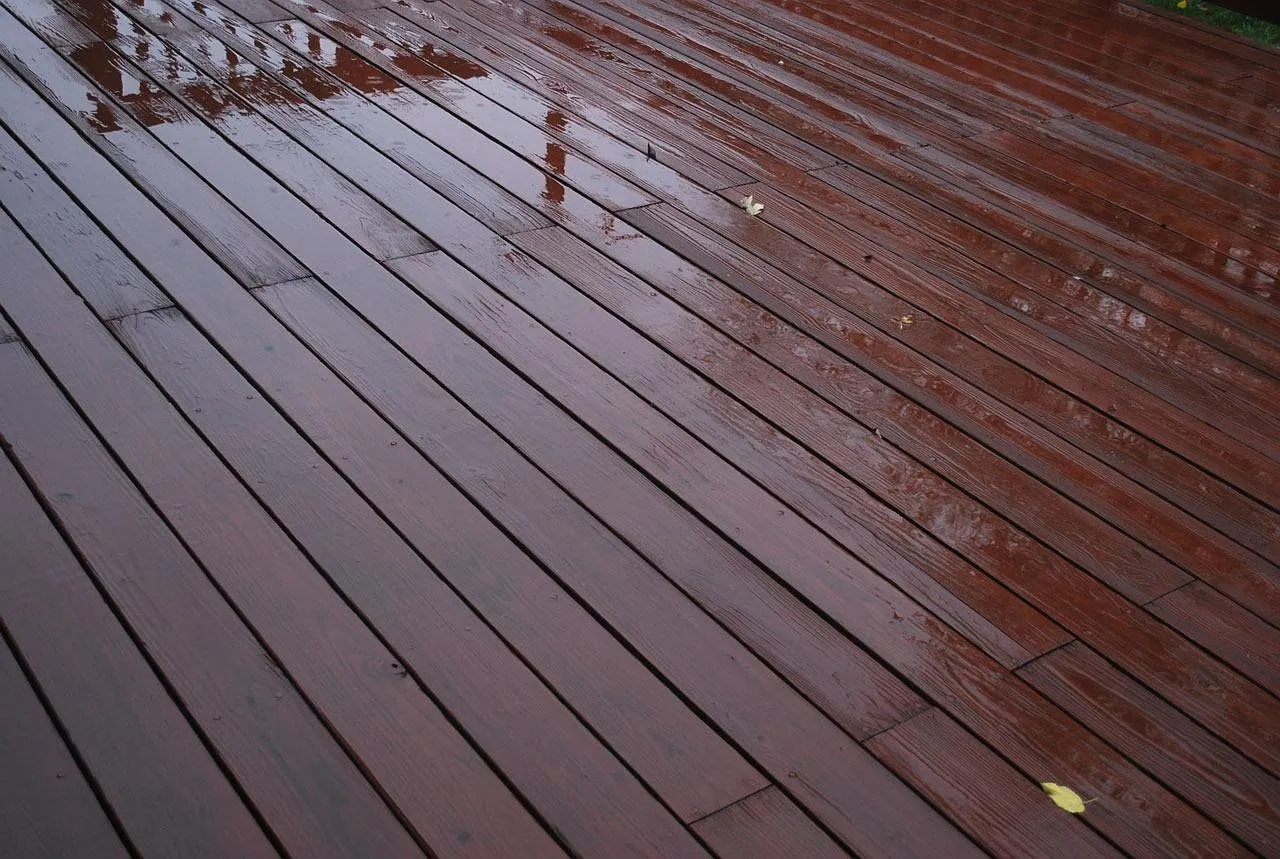
As boards weather, small surface cracks, called checks, are likely to appear from wetting and drying. WoodSolutions says they are part of wood’s natural character and have no effect on the structure; a finish slows them down.
Grey, rough, slippery
Without maintenance, boards discolour and the surface becomes rough and prone to splinters. Mould can make a poorly kept deck slippery; slip resistance can be improved with finishes that contain anti-slip particles, or slip-resistant strips.
Stains
Tannin from hardwood can wash onto paving below. Iron filings, for example from cutting metal, bricks or tiles with an angle grinder near the deck, react with the timber and leave black stains. Some pine boards can bleed resin in hot weather.
The safety check
The annual inspection WoodSolutions suggests covers the balustrade as well as the deck. The heights and gaps a barrier must keep are set by the building code; the balustrade guide quotes them in full, so you can compare what you see with what the code requires.
If the deck is close to the ground, WoodSolutions’ guide prefers a panelised design whose panels can be lifted for maintenance and inspection, and a perimeter left open for ventilation.
On bush fire prone land
The RFS’s home preparation actions include removing material that can burn around your home, which it lists as “door mats, wood piles, mulch, leaves, outdoor furniture”, and cleaning up fallen leaves, twigs and debris around the property. The bush fire guide covers building a deck on mapped land.
Keep a log of your own
WoodSolutions recommends establishing a maintenance log from the outset, recording coating types and application dates, sealant locations and renewal history, and any replacement or treatment of elements such as decking boards. NSW Government suggests keeping care-and-maintenance manuals from the builder and the warranty and instruction sheet for any anti-termite protection work.
If you rent
NSW Fair Trading says faults or damage to decks or balconies should be noted on the condition report at the start of a tenancy, and that a tenant should contact the landlord or agent as soon as possible when something breaks or needs fixing. Landlords must keep a rented home in a reasonable state of repair.